Code: 10456
Dimensions:
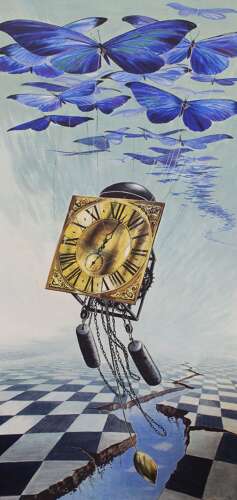
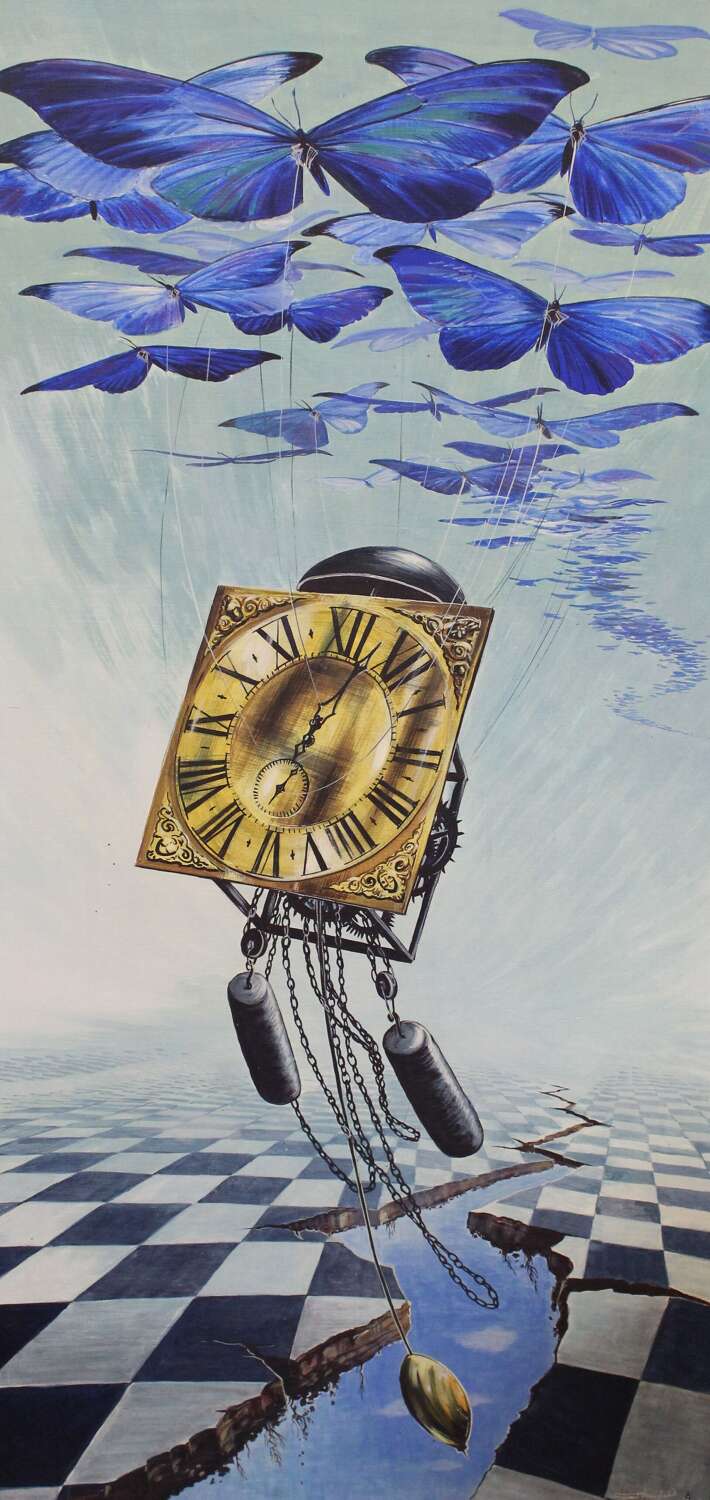
'The Last Hour' egg tempera on prepared panel 900 x 440mm by Stuart Maxwell Armfield (1916-2000) signed to lower right complete with a closed-corner gold metal-leaf over red bole slip within a closed-corner gold metal-leaf over red bole frame. Well, cry your eyes out Salvador Dali for here is a Surrealist masterpiece that stops you in your tracks and draws you in! Time flying away from you whilst butterflies fly above enjoying their single day of life oblivious that the end is never far away from them, they simply go with the flow and don't fight it, but hold on savoring and enjoying every passing minute.
Stuart was born in Sanderstead, near Croydon, Surrey, but grew up in Somerset. He studied design and the history of architecture at the Royal West of England College of Art in Bristol, then from 1934 to 1939 was Assistant Art Director at Ealing Film Studios. A Quaker pacifist, he returned on the outbreak of World War II to the home of his parents in Axbridge, Somerset. After a nervous breakdown, he moved in 1942 to Polperro where he and his partner George Bray, lived high above The Warren in their home 'Tycara'. He was renowned for his use of the traditional egg tempera technique, a skilled process that uses egg yolk to bind pigments a method which dates from the Byzantine world of the early Middle Ages. His cousin, the painter and writer Maxwell Ashby Armfield, taught him the tempera technique, which Stuart developed and in 1958 published a book on the subject in the Artists Handbook series. By 1945 he felt confident enough to take up painting as a full time professional career. He exhibited in the Summer Exhibitions at the Royal Academy of Arts in London and with the St Ives Society of Artists of which he was a member. Encouraged by his successful artist uncle Maxwell Armfield he adopted permanently took up the use of tempera which he called "The be-all and end-all of painting" and was very keen on promoting the use of this age old traditional skill through its use in the creation of his pictures. He particularly favoured the medium for its translucency and ability to depict clean lines, razor sharp detail and bright colours which zing out at the viewer.
Stuart's principal subject matter was still life and unusually, the backdrops were generally an infinite space, evoking sea or sky in such a way as to suggest the influence of surrealism. Reviews of his work shown at the exhibitions of the East Cornwall Society of Artists and Plymouth Arts Club in the 1940s and 1950s praised the skill of his tempera technique. The paintings included in his first STISA exhibition in 1950 attracted much favourable attention as did his solo show in the summer of 1956 at Plymouth Arts Centre which was opened by fellow Polperro resident Jack Merriott.The 1950s and 1960s marked the highest point of his career, with several exhibitions in the USA establishing a following there.
Between 1958 and 1970 he shot a series of films in and around Looe, some of which have been uploaded onto YouTube by Cornish Voices. In 1965 he opened a gallery on the quay in Looe and in 1966 relaunched The Cornish Review where from then until 1970 Armfield was the portrait artist for the publication. In 1971 he held an exhibition at The Orangery, Saltram House, which was opened by Lady Trehane. In the same year he was involved in the renovation of the Jubilee Inn, Pelynt, creating an original design for its glazed circular staircase.
Plymouth Art Gallery held a major retrospective of his work in 1977. Two years later he moved to Plymouth, converting a dilapidated building on the Barbican into a new studio and gallery.