
Code: 10076
Dimensions:
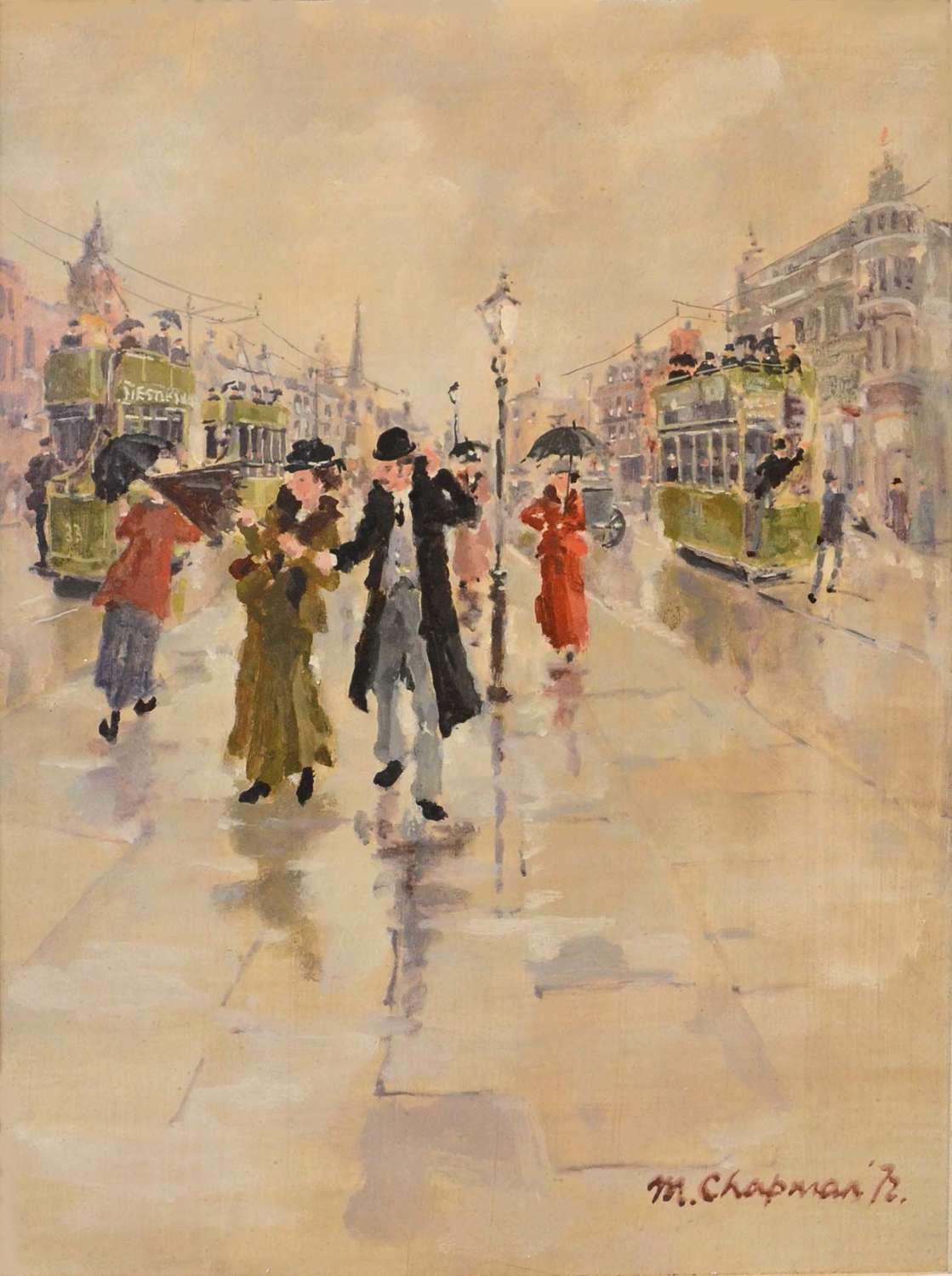
'Showers, Manchester' original oil on board by Margaret Chapman (1940-2000) signed and dated '72 to lower right complete with a closed-corner hand-painted pale cream slip within a closed-corner frame in gold metal-leaf rubbed through to black bole on sight edges.
Eileen Margaret Chapman ~ nee Duxbury was an English illustrator and painter born on 18 November 1940 at Durham Road, Darwen, Lancashire the second child to parents Ethel Duxbury (nee Pearson 1911–1992), a seamstress, and Alan Holt Duxbury (1906–1955) the chief accountant for the North West Gas Board. Ethel recalled how the birth was during an air raid over the cotton mill town, and a neighbour suggested she call her daughter 'Sirena' as sirens had been wailing when Margaret was born. She had an older sister, Kathleen Mavis (1938–2004). The family lived in Darwen for a number of years, where there were many aunts and uncles and Ethel's parents James and Bertha, until Alan Duxbury's accountancy job took them first to Stalybridge and then St Helens. Her great-uncle was Charles Lightoller, who was second officer of the RMS Titanic and a survivor of its sinking.
Margaret was a gifted student, showing ability in maths and English as well as art. She passed her Eleven Plus examination a year early and was enrolled at Coley School in St Helens. She said of her first day at the school "I was terrified, literally shaking with fear, every girl was bigger than me it seemed and I had no friends at all; I cried in private." Her skill at painting was obvious from an early age and she studied at Liverpool College of Art alongside Stuart Sutcliffe, with whom she competed for 'best painter in class'.
Her oil and gouche paintings often featured Edwardian street scenes, usually in the north of England, and drew favourable comparisons with L S Lowry, with whom she was often thought to be a contemporary despite being more than fifty years younger. Chapman's work is often more detailed, with many works featuring billboards selling products of the Edwardian Period such as Bovril, Cadbury's confectionary and Oxo. She matched Lowry for prices in the early to mid 70s, and interest in her work has steadily increased over the twenty five years after her death.
Well known works include 'Piccadilly Circus', 'The New Rover', and 'Pretty Polly' all with typically busy crowds fascinated with a snake oil salesman or an itinerant gas iron seller.
While studying at art college and living at nearby at Gambier Terrace sharing lodgings with Stuart Sutcliffe and John Lennon, she recalled a young Paul McCartney and George Harrison coming in through an upstairs window via a back fire escape to rehearse with her flatmate John Lennon. While they were students in Liverpool, where she was affectionately known as 'Duckie, she introduced John Lennon to the novel 'The Catcher in the Rye' by J D Salinger.
She married in 1965 and had four children and by 1970, after five years of marriage and with three young children, she decided to seriously take up painting again. She was motivated to record something of the local Lancashire townscapes, which were undergoing big changes as a result of town planning. She was attracted to the lifestyle of an earlier age, particularly the Edwardian period, respecting the strength of character and traditions of ordinary folk from that time. She was meticulous in recording the period accurately in her work, in terms of the figures, clothing, billboards and buildings as these provided the rich content and context for which she became renowned. Her skill in the medium was soon apparent and easily recognised from its distinctive style, and it wasn't long before her work was noticed as a result of small exhibitions in local libraries in Darwen and Blackburn. This provided the opportunity for her first major exhibition in Manchester of more than 30 paintings. This first exhibition was an opening-night sell-out, which would become a common occurrence at future shows, some of which were attended by contemporary artists such as Laurence Stephen Lowry and Vladinir Tretchikoff.
By 1974 the intrinsic value of her paintings were topping £1,000 each and were on a par with her fellow Lancastrian artist Laurence Stephen Lowry (1887-1976). The Guardian newspaper famously headlining a London auction of Northern Artists with "Mrs Chapman gives Lowry a run for his money." Everything she painted was sold more or less immediately, with clients from all over the world requesting works. She featured regularly on local and national TV, memorably in 1972 on the BBC's The Succeeders a programme which featured individals who were at the height of their profession and likely to be so in the future. Her paintings were also regularly shown in the national and international press. Which, in one sense, presented her with an ideal situation, as it allowed her to maintain an orderly family life, with four children under eight by 1973, and let her paintings and drawings speak for themselves. However, as a consequence, she had few exhibitions with most of her original work being sold before reaching a wider audience.
She painted consistently, prolifically throughout the 1970s, and as her style became more well known, she was invited to authorise reproductions of her best known work, to give her countless fans worldwide an opportunity to enjoy her art. Famous collectors included the England football captain of the time Jimmy Armfield and several members of the cast of Coronation Street. In 1978 she wrote and illustrated two books entitled 'When Steak was a Shilling a Pound' and 'In Great Great Grandmother's Day' featuring her paintings with her own prose and thoughts on the Edwardian period. In 1977 Margaret recalled her childhood in an interview on BBC1's Look North (now BBC North West Tonight), saying "It was such a contrast, or seemed to me as a child, to move from the soot-blackened factories and terraced houses of Darwen to the relative luxury of a semi-detached in the suburbs, which is what happened when my father's work took us there". "I think those early cotton mill town days and the hard-working folk rushing to work I saw every day made a lasting impression upon me. It wasn't until a long time later that I attempted to capture in paintings the spirit of that busy movement and activity."
Here in 2025 interest in the female artist is on the rise and Margaret's work is more poignant than ever, evoking an immediate response from the viewer, surely they are modern masters to appreciate that will invariably appreciate.
