Code: 10495
Dimensions:
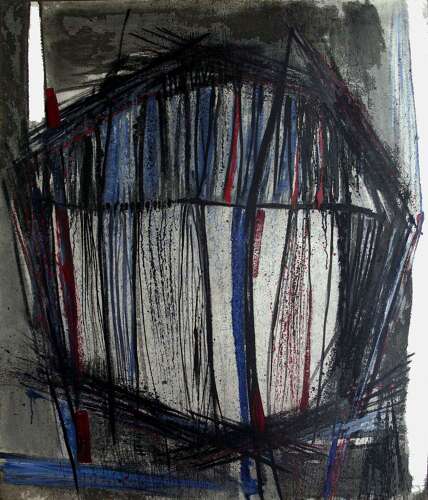
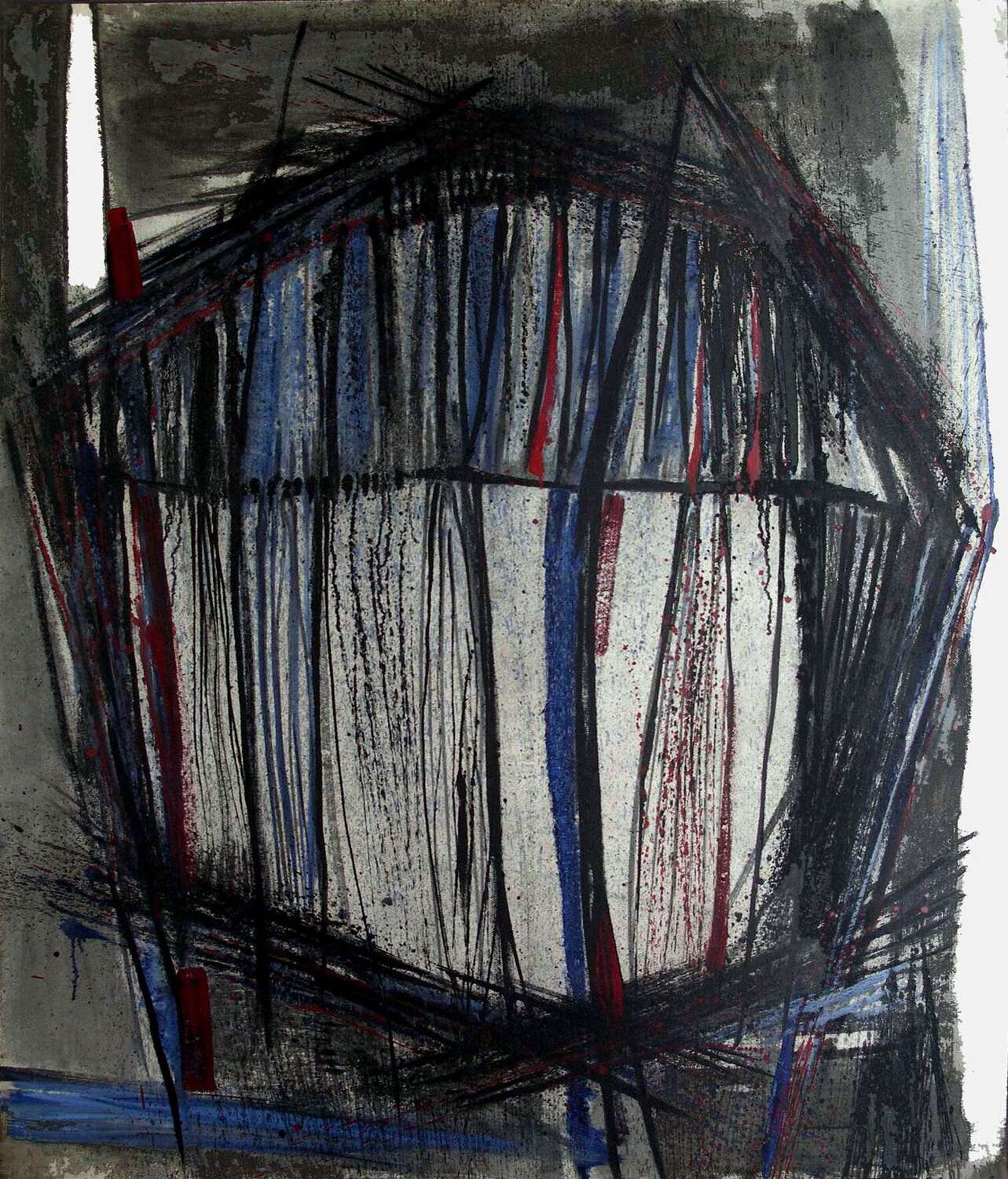
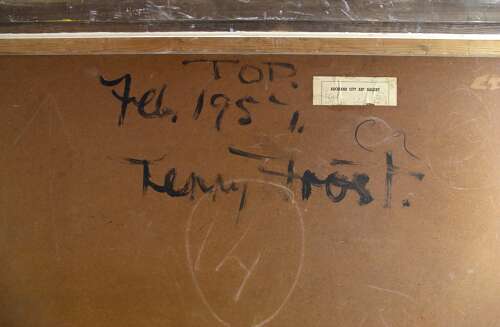
'Winter, February 1957' oil on board 1475 x 1218mm by Sir Terence Ernest Manitou Frost RA (1915-2003), dated Feb 1957 and signed to verso.
Terry Frost’s ‘Winter, February 1957’
The various phases of Frost's painting in the 1950s are well documented; the development of his art from the early St Ives works into the broader gestural manner that he adopted during his time in Leeds is a feature of virtually every piece of writing on the artist.
The institution of the Gregory Fellowships at Leeds University by E.C. 'Peter' Gregory in 1950 was a remarkably prescient piece of private patronage. The novel idea of instituting positions that would bring leading artists into the ambit of the city was remarkably successful, and was seen as a positive experience for both the artistic life of Leeds and the painting and sculpture fellows themselves.
With his characteristic gusto, Frost threw himself into the position, and the crosspollination of ideas with other institutions was responsible for awakening an interest in contemporary art in many who were later to become important supporters. In his essay 'The Leeds Connection' (published in David Lewis) one of these, Ronnie Duncan, wrote a memorable account of Frost's involvement in this period.
Frost responded well to the expansiveness of the Yorkshire landscape, the characteristic colours and forms that began to appear within a relatively short time of his arrival in Leeds begin to create images that are very definitely distinct from his Cornish work. One of the most distinctive is the polygonal form that first appears in the paintings of 1956, the genesis of which Frost noted as deriving from one particular occasion: “I drove through the snow and had lunch with Herbert Read…...After lunch we went for a walk…...I looked up and I saw the white sun spinning on top of a copse…...now I recall that I thought I saw a Naples yellow blinding circle spinning on top of black verticals. The sensation was true. I was spellbound and, of course, when I tried to look again 'it' had Gone, just a sun and a copse on the brow of a hill covered in snow. I do remember my heart almost stopped at the experience and it was gone.”
Chris Stephens, in his book ‘Terry Frost’ published in 2000 by Tate Gallery publishing Ltd, highlights the fact that the development of new themes and motifs in Frost's work is actually a rather more lengthy process than perhaps this quotation suggests. Performing a function that allowed the artist to suggest receding depth within his paintings, this motif was to become a standard part of Frost's painterly vocabulary for the next few years and was considered particularly successful by his contemporaries.
This new element was particularly praised by Patrick Heron, who wrote in 1957 of the way in which Frost had begun to develop the form: “In Frost's new work an overtly geometric (and somehow symbolic) form lies involved in the downward-moving rain of pigment gestures...a broad compositional structural statement lying behind the bead-curtain of dribbles, that gives the picture that power and punch, that three-dimensional focus and concentration of space that no purely Tachist picture ever exhibits” (Patrick Heron, 'London', Arts, vol.32 no.1, October 1957 p.17).
The vigour with which the present painting is executed certainly backs up the feeling of a directly transmitted idea implicit in the artist's own writing, and there are virtually no passages of reworking. The balance and impact of the areas of colour carry a great deal of power against the stark network of black and white, each seemingly having a presence greater than the actual area of pigment might suggest and the rough dry texture of the paint is still redolent of the crisp snowy landscape that inspired it.
Michael Wood
October 2002