Code: 10519
Dimensions:
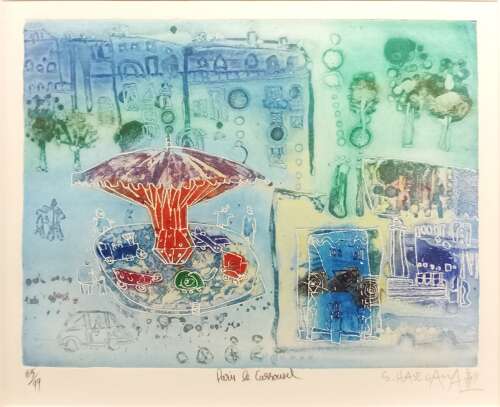
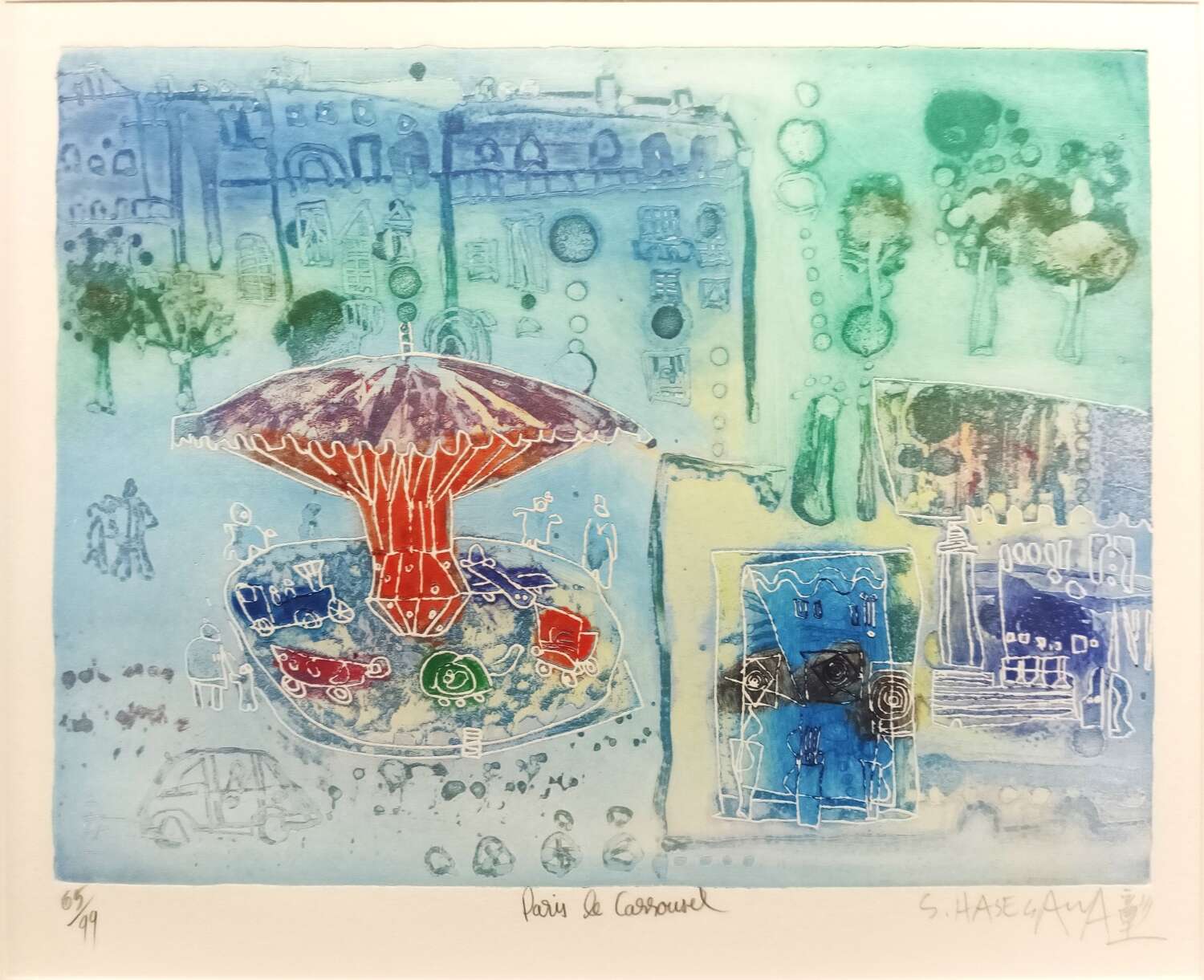
'Paris le Carrousel' original print: etching with aquatint image size: 240 x 315mm by Shōichi Hasegawa (1929-2023), numbered 65/99, titled and signed in carbon pencil to the lower margin with a square-cut double over-mount with a bevel fillet insert within a closed-corner hand-painted white frame with a pale blue wash and glazed with an overall size of: 550 x 594mm
Shōichi Hasegawa, a Japanese painter and graphic designer residing in Paris, began his artistic journey after joining the Japanese Hasegawa Post Office in Yaizu. While working there, he discovered his passion for drawing and decided to pursue an apprenticeship as a painter. From 1945 to 1951, he underwent training and studies under the guidance of Yoshinari Koga, a locally renowned artist known for realistic portraits and landscapes. Hasegawa later moved to Tokyo and attended the Koguga Academy to further his studies in painting.
During his time in Tokyo, Hasegawa was greatly influenced by Tasuku Kasukabe, a notable watercolorist, who introduced him to an association of watercolorists. Hasegawa participated in their exhibitions and found inspiration from their work. Another significant influence on Hasegawa's artistic development, both technically and conceptually, was his acquaintance with Kawaguchi Kigau, a renowned Japanese painter who had been involved in the research of Cubism and Surrealism in 1920s Paris.
In 1961, Hasegawa and his wife relocated to Paris to learn the art of printmaking, a technique not widely used in Japan at the time. He became a student at the Hayter studio, which was considered the birthplace of printmaking for artists in France. In Paris, Hasegawa's artistic style became increasingly influenced by European art, particularly evident in his works' connection to Paul Klee. Additionally, his watercolors, characterized by their transparency, density, and symbolic encoding, bore the influence of Mark Rothko's lyrical abstraction. Hasegawa employed soft pastel palettes and layered textures to reflect the meticulous process of creating his artworks.
Apart from color prints, Hasegawa's body of work includes watercolors and oils, where delicately shaded color areas harmonize with subtle lines, often hinting at figurative elements. The coloring often creates an ethereal and undefined sense of space. His Japanese heritage is visible in his skillful use of empty space, a significant aspect of his image compositions. Hasegawa's contribution to contemporary Japanese art has been widely recognized, and he has participated in numerous solo and group exhibitions both in Japan and abroad. His artworks can be found in prestigious collections worldwide.
Hasegawa's unique artistic style, combining abstraction with elements of nature, has made a lasting impact on the history of art in Japan and has served as inspiration for many artists and admirers across the globe. Today, his paintings and delicate prints are housed in esteemed institutions such as the Bibliothèque nationale in Paris, the Museum of Modern Art in New York, the Victoria and Albert Museum in London, the Norrköpings Museum of Art, and the Museum Fuji in Tokyo. Hasegawa used to reside and work in Val-d'Oise, France, the same location where the renowned Impressionist master Claude Monet once lived. In addition to his artistic endeavors, Hasegawa also served as a professor at Musashino University of Fine Arts, where he trained and influenced multiple generations of artists.
Why invest in Shōichi Hasegawa?
1. A unique artistic path: Hasegawa's artistic journey began from humble beginnings as a radio operator, and his subsequent transition to painting shows a compelling narrative that adds depth and meaning to his work.
2. Diverse training and influences: Hasegawa underwent extensive training under Yoshinari Koga and Tasuku Kasukabe, enriched by Parisian training and the influences of Klee and Rothko.
3. International perspective: Moving to Paris and studying at the Hayter studio provided Hasegawa with exposure to European art and the opportunity to fuse his Japanese heritage with Western artistic influences, resulting in a unique fusion of styles and ideas.
4. Technical mastery: Hasegawa's mastery of several techniques, including printmaking, watercolors, and oils, demonstrates his versatility as an artist and showcases a wide range of artistic expression.
5. Symbolic and ethereal imagery: Hasegawa's works are characterized by transparency, density, and encoded symbolic elements, creating a captivating and ethereal quality that engages viewers on multiple levels.
6. Skillful use of color and texture: The artist's use of muted pastel color palettes and layered textures adds depth and dimension to his works, reflecting the meticulous process and emphasizing the tactile nature of his art.
7. Delicate figurative hints: Hasegawa's paintings and prints often incorporate subtle figurative elements, inviting viewers to explore the intersection between abstraction and representation, blurring the boundaries between the two.
8. Strong artistic legacy: Hasegawa's significant contributions to contemporary Japanese art have earned him the recognition and respect of the art community, making his works a valuable addition to any art collection.
9. Presence in prestigious collections: Hasegawa's works can be found in prestigious institutions around the world, such as the Bibliothèque nationale in Paris, the Museum of Modern Art in New York, and the Victoria and Albert Museum in London, testifying to their cultural value and significance.
10. Influence and inspiration: Hasegawa's unique artistic style, combining abstraction with elements of nature, has left a lasting impact on art history in Japan, inspiring successive generations of artists and earning him a place of admiration and influence in the art world.