Code: 10494
Dimensions:
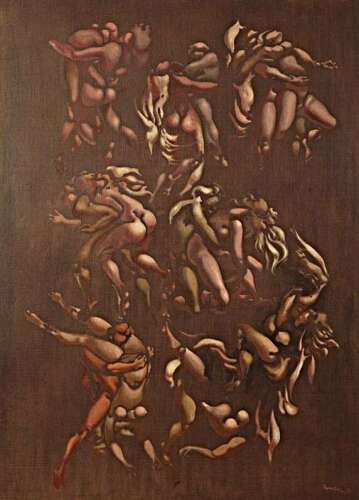
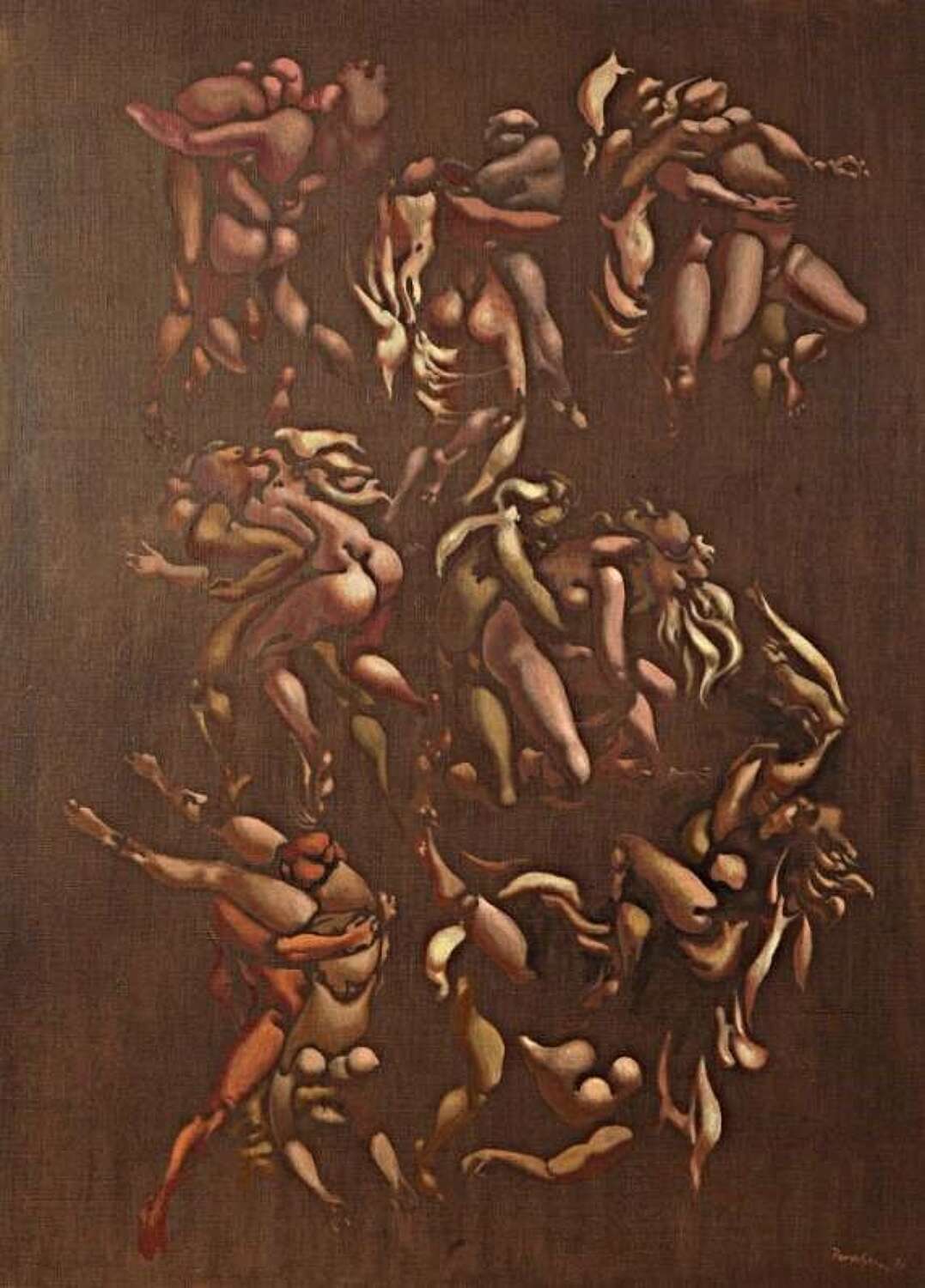
'Alphabet Erotic' 1970 oil on stretched canvas 990 x 720mm by Jules Perahim (1914-2008) signed and dated '70 to lower right complete with wooden gilded frame overall size: 1065 x 895mm
Born under the name of Jules Blumenfeld into a family of Jewish intellectuals from Bucharest, the artist became known under the nickname Perahim in 1930. Initially a student of the painters Nicolae Vermont and Costin Petrescu, professors at the School of Fine Arts in Bucharest, he distanced himself from their teaching and in 1930 became one of the leading figures of the Romanian artistic avant-garde. He collaborated with the magazine Unu (1930-1932), notably with Victor Brauner and Jacques Herold. In 1930 with young poets, including Gherasim Luca, he wrote in the nonconformist magazine Alge, which was published in various formats between 1930 and 1933 earning them a few weeks in prison for moral offenses. In 1932 he exhibited paintings in Bucharest that were considered to belong to the Surrealism movment: 'Dream of a Young Girl', 'A Cypress Crossing the Sea', 'Perfect Balance' etc.
In 1936 the exhibition of paintings and drawings opened in Bucharest imposeing iself by the violence of the images which, in a fantastic vision, stood up against the rise of the repressive agents of thought: Profiles of a Morality, Father-in-Law's Game, etc. and the functioning of the established power 'Board of Directors', 'Lumpenproletariat and Aristocracy', 'Manpower', etc.
In Prague in 1938 Perahim exhibited in the foyer of A. F. Burian's innovative theatre, frequented by artists and writers of the Czech avant-garde where he met the German Dadaist artist John Heartfield, known for his anti-Nazi photomontages. Without being able to go to Paris, whereVictor Brauner and Gherasim Luca were already located, he was forced to return to Romania in the midst of the rise of the violently anti-Semitic far right.
Threatened and pursued by the Iron Guard, both for his left-wing opinions and for the corrosive cartoons published in the democratic press: Cuvantul liber, Reporter, etc he took refuge at the end of 1940 in Bessarabia (Moldavia), which had become a Soviet Republic. In June 1941, after the attack by the German army, he fled with the civilian population, submitted to compulsory labour and working in makeshift jobs: a peasant worker in a Kolkhoz. He crossed the Caucasus on foot and arrived in Armenia where he earned his living by creating sets and costumes for a theatre reserved for the war wounded in Kenaker, near Yerevan. Mobilized in March 1944 in Moscow he became an illustrator and graphic presenter for the anti-fascist Romanians magazine Graiul Nou. Perahim returned to Romania at the time when war was declared on the Axis.
In the 1950s during the Stalinist period during , Perahim produced impersonal images in accordance with the imperatives of an art directed in the aesthetics of socialist realism. He renounced personal painting to submit to the subjection of food to imposed themes. Nevertheless, he was actively involved in the development of an "art for the forum": mosaic wall decorations 'House of culture in Mangalia, Romania' etc, cycles of engravings 'Proverbs and sayings in 1957', book illustrations for Romanian and universal literature. Only the creation of theatre sets in 1957 for 'The Bath' by Vladimir Mayakovsky; 1958 'The Hammer Without a Master' by Pierre Boulez sand the creation of ceramic forms and decorations (exhibition in Bucharest in 1965) which allowed him, during these years, to return to expressive research, far from socialist realism.
His art is recognized in his country: state prize, honorary title of master emeritus of art, and in international circles: gold medal at the Leipzig Book Fair, silver medal at the Milan Triennale, laureate of the International Theatre Festival of Epidaurus in Greece and honorary member of the Academy of Drawing in Florence. Between 1948 and 1956 he worked as a professor of graphic arts and scenography at the Institute of Plastic Arts in Bucharest. He was then editor-in-chief of the magazine Arta Plastica from 1956 to 1964. From that date forward, Perahim began to paint again and resorted to exercises designed to "force inspiration": Max Ernst, transfers, rubbings, collages etc many exhibited in Paris in 1968, where he permanently settled in 1969.
Followed by his work being the subject of some forty solo exhibitions in France: A. F. Petit and M. Calatchi galleries in Paris 1900-2000, Jacques Verrière gallery in Lyon and abroad. In addition Perahim has been exhibited on numerous occasions in prestigious group exhibitions: 'Museum of Fun' organized in 1984 by Asahi Shinbun of Tokyo; 'Art and Alchemy' Venice Biennale in 1986; 'Surrealism and Love' at the Musee d'Art moderne de la Ville de Paris in 1998; Marcel Duchamp e altri iconoclasti anche at the National Gallery of Modern and Contemporary Art in Rome1998; Hypnos Contribution to a visual history of the unconscious at the Lille Metropole Musee d'Art moderne, d'Art contemporain et d'Art brut in 2009 and in international fairs: Basel, Milan, Bologna, Ghent and Fiac in Paris. From the 1990s he was again represented in Romanian exhibitions dedicated to the avant-garde.
During these 40 years of life in France his painting and drawings presented a universe of enchantment. Travels in Southern Africa left deep traces in his creation, imbued with an intense vitality stemming from the "Universal communication, of a hybridization of all forms of life in a generous sensuality that commands and directs the symbiosis of all the elements" Perahim's world remains open to all combinatorial fantasies: a fabulous bestiary bringing together the animal and the vegetable, the mechanical and the living, large-scale illusionist landscapes crossed by surprising and incantatory shapes.
His work can be found in many public collections: National Fund for Contemporary Art in Puteaux; Museum of Contemporary Art in Rome; Israel Museum in Jerusalem; National Art Museum of Romania in Bucharest.
Perahim is affiliated to the Society of Authors in the Graphic and Plastic Arts (ADAGP). His wife Marina Vanci-Perahim, art historian and professor emeritus at the University of Paris Pantheon - Sorbonne, holds the moral, intellectual and patrimonial rights of the artist.
He is buried in Paris in the Pere-Lachaise cemetry (7th division).